
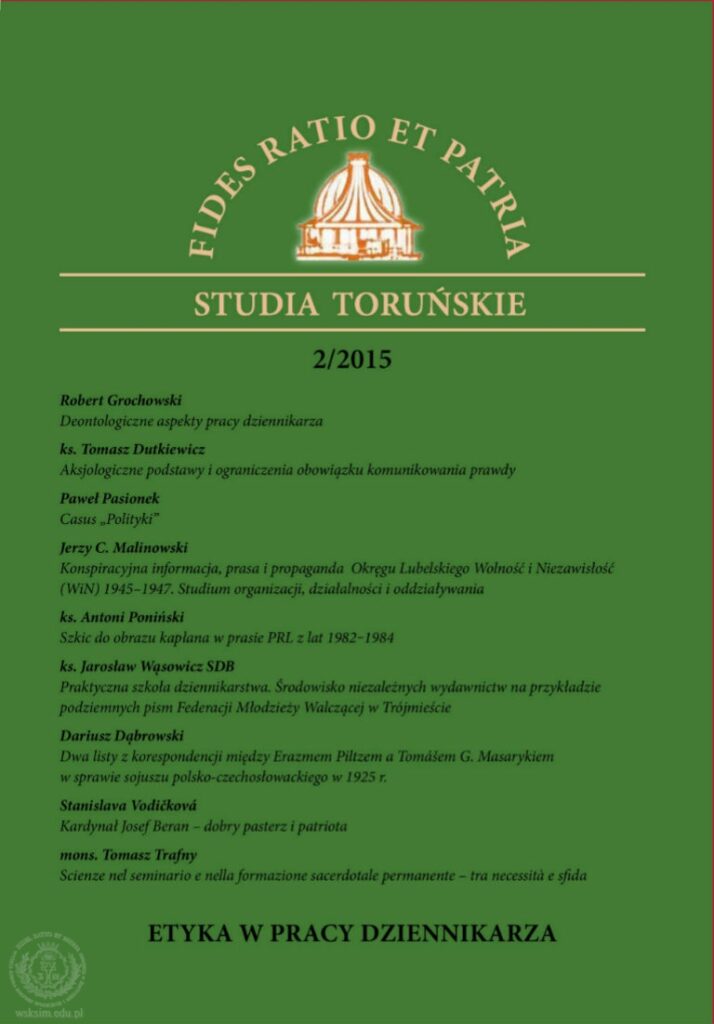
Drugi numer półrocznika naukowego poświęcony jest w dużej części etyce pracy dziennikarza. Wolne media uważane są dzisiaj za czwartą władzę, która pełni funkcje kontrolne wobec trzech pozostałych (ustawodawczej, wykonawczej i sądowniczej). Ta niezwykle wysoka ranga środków masowego przekazu powoduje, że praca dziennikarza nie polega tylko na prostym wykonywaniu czynności zawodowych. Jest ona także powołaniem do służby dla społeczeństwa. Służby opartej na wysokich standardach etycznych, na dążeniu do poznawania prawdy, piękna i dobra, na miłości Boga i bliźniego. Dla tych wartości dziennikarze często ponoszą wielkie ofiary, nawet życia i zdrowia. W opublikowanych poniżej artykułach Jerzego C. Malinowskiego i Jarosława Wąsowicza SDB znajdujemy przykłady takich ofiar ponoszonych przez dziennikarzy prasy podziemnej w czasach komunistycznych. Dobry dziennikarz, to dziennikarz odważny, a równocześnie dążący do rozpoznania prawdy, daleki od działalności propagandowej i od rozmaitych uwikłań, opisywanych w tym numerze przez Pawła Pasionka, ks. Antoniego Ponińskiego i Przemysława Ruchlewskiego. Dziennikarz powinien też rozumieć, że również informowanie ma swoje granice, o czym piszą w niniejszym zeszycie Tomasz Dutkiewicz i Robert Grochowski. Ten ostatni rozważa zresztą szereg innych ograniczeń etycznych w pracy dziennikarskiej. Mamy nadzieję, że zarówno te, jak i inne teksty opublikowane na łamach naszego pisma wzbudzą zainteresowanie i będą zarzewiem do ciekawych rozważań i dyskusji. Liczymy, że sięgną do nich nie tylko naukowcy i studenci, ale również dziennikarze – przedstawiciele zawodu, który tak wielką rolę odgrywa w dziejach współczesnego świata.
Etyka w pracy dziennikarza (Ethics at Work journalist)
Spis treści (Contents)
Wstęp (Introductions), s. 6
Robert Grochowski, Deontologiczne aspekty pracy dziennikarza (The deontological aspects of journalst’s work), s. 7
Tomasz Duktkiewicz, Aksjologiczne podstawy i ograniczenia obowiązku komunikowania prawdy (Axiological foundations and limits of the duty to communicate the truth), s. 17
Paweł Pasionek, Casus „Polityki” (Casus “Polityki”), s. 30
Jerzy C. Malinowski, Konspiracyjna informacja, prasa i propaganda Okręgu Lubelskiego Wolność i Niezawisłość (WiN) 1945–1947. Studium organizacji, działalności i oddziaływania (The underground information, the press and propaganda of the Lublin District of Freedom and Independence (Wolność i Niezawisłość – WiN) 1945–1947. The study of organization, activityand impact), s. 44
Przemysław Ruchlewski, Kampania propagandowa w grudniu 1970 r. w świetle prasy regionu bydgoskiego ( „Nowości”, „Ilustrowany Kurier Polski”, „Gazeta Pomorska”) (The propaganda campaign in December 1970 in the light of the press in Bydgoszcz region (‘Nowości’, ‘Ilustrowany Kurier Polski’, ‘Gazeta Pomorska’)), s. 87
Antoni Poniński, Szkic do obrazu kapłana w prasie PRL z lat 1982-1984 (The image of a priest in communist newspapers from the years 1982-1984), s. 124
ks. Jarosław Wąsowicz SDB, Praktyczna szkoła dziennikarstwa. Środowisko niezależnych wydawnictw na przykładzie podziemnych pism Federacji Młodzieży Walczącej w Trójmieście (Practical school of journalism. The environment of independent publishers in the Tri-City on the example of underground magazines of the Fighting Youth Federation), s. 135
Dokumenty (Documents)
Dariusz Dąbrowski, Dwa listy z korespondencji między Erazmem Piltzem a Tomášem G. Masarykiem w sprawie sojuszu polsko-czechosłowackiego w 1925 r. (Correspondence between Erasmus Piltz and Tomáš G. Masaryk about Czechoslovak-Polish alliance in the mid-twenties twentieth century), s. 153
Varia
Stana Vodickova, Kardynał Josef Beran – dobry pasterz i patriota (Cardinal Josef Beran – a good shepherd and patriot), s. 165
Tomasz Trafny, Scienze nel seminario e nella formazione sacerdotale permanente – tra necessità e sfida (Science in the seminar and in priestly formation permanent – between necessity and challenge), s. 186
Józef Dębiński, Udział duchowieństwa katolickiego w życiu politycznym i społecznym Polski w latach 1918-1939 na przykładzie diecezji włocławskiej (The participation of catholic clergy in social and political life of Poland in the years 1918-1939, the example of the Włocławek Diocese), s. 204
Wojciech Polak, „Powiedział, że w czasie stanu wojennego nie użyje broni nawet gdyby mieli go rozstrzelać”. Sprawa podchorążego Andrzeja Wrony (“He said that he would not use weapons during the martial law even if he had to pay for this decision with his own life”. The case of cadet Andrzej Wrona), s. 226
Judyta Bielanowska, Podziemna i niezależna działalność Książnicy Miejskiej (Kopernikańskiej) w Toruniu (Underground and independent activity of Municipal Library the name of Mikołaj Kopernik in Toruń), s. 255
Artykuły recenzyjne (Books reviews)
Józef Dębiński, Wołyń 1943. Pamięć złych czasów i symbol pojednania?, pod redakcją Sylwii Galij-Skarbińskiej, Toruń 2014, ss. 181, s. 285
Józef Dębiński, Ludzie wolności w regionie kujawsko-pomorskim, pod redakcją Michała Białkowskiego, Zdzisława Biegańskiego, Wojciecha Polaka, Toruń 2014, ss. 324., s. 289
Underground and independent activity of Municipal Library the name of Mikołaj Kopernik in Toruń
The article „Underground and independent activity of Municipal Library the name of Mikołaj Kopernik in Toruń” is taking issues of functioning NSZZ “Solidarność” in Toruń library in the period from 1980 to 1989. In first his parts were portrayed historical conditioning and circumstances of the coming into existence and next factors which decided the vocation and the registration of the „Solidarność” were specified. Next activity conducted during legal functioning, including the propaganda activity above all and the influence on the society were discussed, especially relating to events associated with the Bydgoszcz crisis and beating Jan Rulewski up. Later action taken after implementing the martial law was described, pointing for the issue of the alternative publishing companies and the cooperation with structures underground „Solidarność”. In this context they also indicated individual of action in favour of the storage and the distribution underground publishing companies. They also referred to repressions which during the martial law experienced employees of the Library affiliated in „Solidarność”, especially internments two from them and dismissals from the work. A revival of the „Solidarność” in 1989 was also briefly discussed and her activity in the context of the new political situation. Next the second parts of the article was devoted to fates of chosen members „Solidarność” which suffered negative consequences in relation to one’s commitment oneself into her activity.
Judyta Bielanowska
Uniwersytet Mikołaja Kopernika w Toruniu
“He said that he would not use weapons during the martial law even if he had to pay for this decision with his own life”. The case of cadet Andrzej Wrona
At the moment of imposition of martial law Andrzej Wrona, a fresh university graduate, was performing military service as a cadet in a military unit in Kołobrzeg. On the night of 14/15 December 1981 along with eleven soldiers he was heading in an armoured vehicle for Gdańsk. On the way, Andrzej Wrona got in conversation with accompanying soldiers trying to convince them not to use weapons against workers; he stated that he himself did not take the rifle from the storage. On 15 December Andrzej Wrona was arrested and sentenced by the Navy Court in Gdynia to three years’ imprisonment. Having served his time in Koronowo and, later on, in Potulice, on 12 April 1983 he was released from prison. Then, as he was unable to find an employment, Wrona emigrated to Canada. Only on 5 November 1991 the hearing was held before the Supreme Court and Andrzej Wrona was finally acquitted. Patriotism was a driving force for all his actions. The cadet believed that there were moments when our homeland required self-sacrifice, though the price he had to pay for his honourable and patriotic conduct was extremely high.
Wojciech Polak
Uniwersytet Mikołaja Kopernika w Toruniu
Wyższa Szkoła Kultury Społecznej i Medialnej w Toruniu
The participation of catholic clergy in social and political life of Poland in the years 1918-1939, the example of the Włocławek Diocese
When Poland regained its independence, the catholic clergy actively took part in shaping social and political life of the country. They called for unity, harmony and the need to build a country based on catholic teaching of the Church. The clergy from Włocławek sympathized with the National Democracy – that was the party which had a great deal of support from all bishops of Włocławek. Polish Christian Democratic Party had also a lot of supporters in those days, the Party existed under this name until 1937, when it united with the National Worker’s Party forming Labour Party. You could say that clergy were in favor of social solidarity, whose realization was a corporate system, which should be understood as an authentic socio-economic autonomy, created with the help of the country but the initiative itself come from society. An important external factor, which ordered priests to engage in political affairs, was the social radicalism among the urban and rural population. A peasant movement played here a significant role. The clergy relatively favorable referred to the polish parties such as “Piast” and “Stronnictwo Ludowe”. Priests worked for many organizations, associations, trade unions or school and caring boards. A great deal of efforts had to be put into the functioning of agricultural circles or fire brigades. Priests were involved in the activities of local government, the development of cooperative movement. They performed various functions in educational and cultural organizations. Priests working in industrial factories were involved in trade union movement, whose ideology was based on principles of Christian ethic and the existing social order.
Ks. Józef Dębiński
Wyższa Szkoła Kultury Społecznej i Medialnej w Toruniu
Science in the seminar and in priestly formation permanent – between necessity and challenge
Our society is increasingly dominated by science and technology. Can the Church and its ministers stand on the sidelines? Or should it be involved in the discussion and understanding of the cultural dynamics that drive contemporary society? This contribution considers some motivations to encourage the study of the sciences in the ecclesiastical field, beginning in the seminaries and the permanent formation of priests and also looks at those engaged at various levels in the pastoral field, including the laity. It shows how stereotypes about the world and about the human person have created misunderstandings and schisms within society that still endure within some cultural circles. Some of the challenges are addressed such as the need for good communication and dialogue, and we finish with a reflection on the concept of authority to which we often turn to validate certain affirmations. The contribution does not seek to be exhaustive but to raise some questions as a stimulus for research and reflection.
Ks. Tomasz Trafny
Pontificio Consiglio della Cultura
Cardinal Josef Beran – a good shepherd and patriot
This studie focuses on the personality of Josef Cardinal Beran (1888–1969) in the context of the modern history of the 20th century. The introductory chapters focus on his youth and intellectual maturing during his studies in Rome and his subsequent activities in the spiritual service during the first republic period. The following part depicts Beran’s Nazi imprisonment, his life in the Dachau concentration camp and his return to his homeland. In the turbulent times after the World War II, he was elected an archbishop and went down in history as a major advocate of the autonomy of the church and democratic ideas. The communist regime sentenced him to home imprisonment and he was interned in different parts of the country due to his moral attitude between 1951 and 1965. He spent fourteen years completely isolated from his nation and the church, and under permanent surveillance of the State Security. Towards the end of his life, the communist regime allowed him to depart for the nomination for cardinal in Rome, but without the possibility of returning. The next part of the studie deals concisely with Cardinal Beran’s life in forced exile and commemorates his work done behind the iron curtain for his homeland and the church as well as for Czechoslovak exiles scattered all over the world.
The studie draws on comprehensive research in archives home and abroad – state, private, and church ones; detailed analysis of world and home press; and written memoirs and witnesses’ memories.
Stanislava Vodičková
Instytut Badania Reżimów Totalitarnych w Pradze
Correspondence between Erasmus Piltz and Tomáš G. Masaryk about Czechoslovak-Polish alliance in the mid-twenties twentieth century
The years 1922-1925 was a period of seeking a compromise in the Polish-Czechoslovak relations. This was especially evident during the reign of two Polish foreign ministers Marian Seyda and Alexander Skrzyński. Their active emissary was Erasmus Piltz, formerly deputy Polish in Czechoslovakia, a friend of many politicians, among others Czechoslovak with President Tomáš G. Masaryk. Presented documents concern is the correspondence between the two politicians. With lively business and diplomatic factors favorable international situation came to a rapprochement between the two countries, the result of which was a visit to the Beneš in Warsaw on 19-23 April 1925 r. Contents then Conciliation and arbitration treaty, convention trade and an agreement on legal matters and commercial matters. The continuation of this policy was the return visit of Minister of Foreign Affairs Alexander Skrzyński in Prague, April 13-15, 1926.
Dariusz Dąbrowski
Uniwersytet Karola w Pradze
Practical school of journalism. The environment of independent publishers in the Tri-City on the example of underground magazines of the Fighting Youth Federation
Fighting Youth Federation in Gdansk belonged to the most important anti-communist resistance organizations in the second half of the twentieth century. It was established in 1984 in Warsaw and until 1990 it developed its activities in over a dozen centers throughout Poland. One of the most vigorous centers of the organization operated in Tri-city. Among many dimensions of its independent activities, publishing comes to the fore. Two regional Fighting Youth Federation’s press titles and several dozen of school magazines were being published in Gdansk, Sopot, Gdynia and throughout the region. The process of activation of the youth environment in this regard, an attempt of its assessment and evaluation of the impact which involvement in the underground publishing movement had on the journalistic activities of some Fighting Youth Federation activists after 1990, were all presented in this paper.
Jarosław Wąsowicz SDB
Archiwum Salezjańskiego Inspektorii Pilskiej
The image of a priest in communist newspapers from the years 1982-1984
The article presents the way Catholic priests have been perceived and written about in Polish magazines in the first years after the introduction of martial law in Poland ( 1982-1984). At first the press, whose representatives were approved by the communist authorities, avoided sharp judgements about priests. An exception were the notorious ruthless attacks against bishop Ignacy Tokarczuk and priest Sylwester Zych. The sanctions against priests sentenced for criticizing martial law were not publicized and what is more, it was said that there were not any repressions applied towards them. The open criticism of Pope John Paul II was also avoided, as the communists replaced it with the reprints of foreign texts, obviously those which were unfavourable to the Pope. The communist authorities wanted to convince people that some part of the clergy in Poland supported the government in its ideas, but they could not give any convincing evidence in order to support this fact. When it became clear that the Pope’s pilgrimage planned for June 1983 would finally take place, the way of writing about the church and the clergy in Poland changed almost radically. Some priests were being attacked by name. Evident lies were fabricated against them, such as for instance: collaborating with the Nazis (Fr. Blachnicki), cooperating in supplying the Solidarity underground with the explosives (Fr. Popiełuszko), acting to the detriment of the state and the socialist system, and “interfering” in politics. Particularly active person writing negatively about the church was the government spokesman Jerzy Urban. After the publication of his outrageous text about St. Maximilian Kolbe he started signing his articles using a pseudonym and at the same time intensifying the tone of his publications. He did not hide his aggression against father Jerzy Popiełuszko. The term “sessions of hatred” was created by him and applied to the services celebrated by father Popiełuszko. Urban’s cooperation with the Polish Security Service (SB) was confirmed after some years by the officers of this department, the perpetrators of Fr. Popieluszko’s murder. The image of the clergy in the press of that period is the sum of the negative terms only attributed to them.
Ks. Antoni Poniński
Diecezja Włocławska
The underground information, the press and propaganda of the Lublin District of Freedom and Independence (Wolność i Niezawisłość – WiN) 1945–1947. The study of organization, activityand impact
The autor listed and described the letter and distributed in Lublin District Association Freedom and Independence, also sent „from the top”, this is the Central Area and level. Collected here have been together all available data about these periodicals: the place and the period of their issuance, and the fequency and volume, format, print or reproduction, as well as the names of some of the editors and authors, printers and distributors, type-setters and other helpers. Some titles are also data about the the contents of the said and range publications.
The article shown was the organizing effort and the information and propaganda in Lublin District Association Freedom and Independence, with two peaks of intesity: May-June 1946 (in a referendum) and October-December 1946 (with the election). Rhe vast majority of these efforts was adrresed to civilians, but in very many cases, also to the soldiers of the army of regime and even KBW, who was the formation of more-and russia-indoctrinated and though misconceived we as „an armed” of the ocupations of the regime against the Polish underground independens. In addition toto the Lublin District Association Freedom and Independence civil grid, dissemination of conspiratorial press have volatile propaganda patrols and outright partisan troops. One is, as the Polish army duly uniformed and well armed, with an Eagle at the Crown on the caps – makes in a villages where the population has been reported of a truly public rallies about current events and political and the cause that we all gathered at a rally for several hours the Poles lived in the dream of free Poland.
The autor described also in short propaganda-indoctrinated and terrorist action Russians ond their communist regime in Warsaw to fake and hypocritical „demonstrate” that the conspiratorial Association Freedom and Independence (Zreszenie Wolność i Niezawisłość) will work with explicitly functioning PSL. Also presented was a mechanism for the dissemination of such content contrary to the facts. This manipulation was an excuse to take out terrorist cells that each field party. In addition, the intentionally or as a result of ignorance.
In the conclusion presented was an attempt to estimate the number of information and impact coverage propagandistic Lublin District WiN (Wolność i Niezawisłość = Association Freedom and Independence).
Jerzy C. Malinowski
Wyższa Szkoła Stosunków Międzynarodowych i Amerykanistyki w Warszawie
Casus “Polityki”
Despite the passage of more than a quarter-century since the decline of the Polish People’s Republic a weekly magazine ‘Polityka’, which occupied the second position of the sales results in 2014, has been holding a stable position on the weekly market review.This title was created in 1957 on the initiative of the Secretariat of the Central Committee of the Polish United Workers’ Party. During the period of the PPR (PRL) the weekly was used as a propaganda mouthpiece of the then communist authorities . As a result of this fact, in the 3rd Republic of Poland ‘Polityka’ made efforts to be associated with the center-left in order to lend credence in the eyes of the public. It should be added that at the same time ‘Polityka’ did not avoid presenting clearly on which side of the political scene it stood, which caused that during the election campaigns on its columns it tried to encourage its readers to elections close to the editor’s party sympathies. It is also worthwhile noticing that after the fall of the Polish People’s Republic, the employees of this weekly decided to establish a journalist cooperative, which took over the right to the title. Great changes in the functioning of the magazine were introduced on 28 September 2012 when a limited joint-stock partnership ‘Polityka’ was created. What is more meaningful, not all of 130 employees of the publishing house entered the shareholder as the shares in the limited liability company were covered by only 20 key employees of the cooperative, who thanks to it gained crucial influence on the development plans and editorial policy of the weekly. Thereby in the area of the all-Poland media a cooperative form of ownership ceased to exist, symbolically ending the period of ownership transformation of the media begun after the fall of the Polish People’s Republic
Paweł Pasionek
Wyższa Szkoła Kultury Społecznej i Medialnej w Toruniu
Axiological foundations and limits of the duty to communicate the truth
The moral life of man is full of dilemmas, which is solving instruments worked out on the basis of ethical reflection. It happens that the individual good that man appreciates, and – as such – are demanding a fair protection, come into conflict. So it is in a situation of so-called. verbal aggression, in which a person persistently seeking the answer to the question, demanding disclosure of the truth, which, because of the current person secret questions, or for other legitimate reasons, it should not be disclosed. The aim of the discussion is to identify boundaries, which is subject to the obligation to communicate the truth and to present proposals for solutions to this dilemma, an ethic of natural law.
Ks. Tomasz Dutkiewicz
Uniwersytet Mikołaja Kopernika w Toruniu,
Wyższa Szkoła Kultury Społecznej i Medialnej w Toruniu
The deontological aspects of journalst’s work
The base of a journalist’s work is conveying the truth by means of words, pictures and sounds, which are the only way of human communication. Hence the responsibility which a journalist bears due to his job assumes specific character. After all, journalists and media should always show the objective truth. The knowledge of ethical norms and the ability to apply them in practice is an indispensable skill in journalistic profession. Journalists’ power of influencing the public opinion is particularly huge today and therefore special moral responsiblity rests upon them.
The ethos of a contemporary journalist’s work does not consist in getting rid of their own views but in honesty. The journalistic honesty connected with this ethos refers to the fact that one should not hide facts even though they are contrary to the assumed hyphotesis. A good journalist should be open towards people, respect their opinions and distinctiveness. Therefore, the measure of journalist’s reliability are not their stance but the effects of their work, the discernment of vices and depiction virtues. The source of journalistic unreliability is, in large measure, media’s tendency to seek sensation, which makes them show an incomplete picture highlighting differences, and which in effect winds up a spiral of negative emotions – causing divisions.
Robert Grochowski
Wyższa Szkoła Kultury Społecznej i Medialnej w Toruniu