
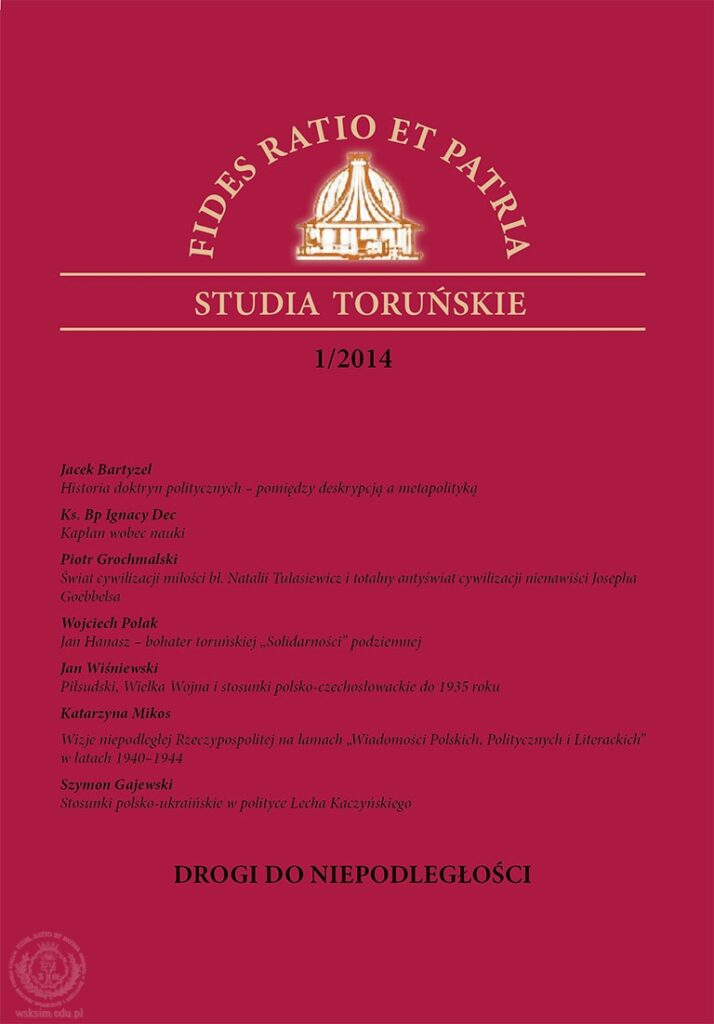
Pierwszy numer półrocznika ukazuje się w roku 2014, w setną rocznicę wybuchu I wojny światowej, podczas której Polacy podjęli owocny trud walki o odzyskanie Niepodległości. Dlatego też najważniejszym tematem niniejszego zeszytu jest polska droga do Niepodległości w ciągu całego XX wieku. Droga niełatwa, bolesna, naznaczona wciąż podkopywaną nadzieją. Lata 80. minionego stulecia miały przynieść upragnioną wolność, ale jak się okazało – co doskonale widać w artykule Siła (bez)silnych. Działania opozycji demokratycznej w optyce SB – środowiska opozycyjne, stanowiące obecnie fundament „demokratycznej władzy”, zostały częściowo zinfiltrowane przez agenturę, która dziś świętuje „25-lecie odzyskania wolności”. Będziemy dokładać starań, aby także następne numery „Fides, Ratio et Patria. Studiów Toruńskich” miały charakter częściowo monograficzny, poświęcony ważnym i ciekawym zagadnieniom.
Drogi do Niepodległości (Roads to Independence)
Spis treści (Contents)
Przedmowa Rektora Wyższej Szkoły Kultury Społecznej i Medialnej (Preface of Rector of College of Social and Media Culture), s. 7
Wstęp (Introductions), s. 9
Jan Wiśniewski, Piłsudski, Wielka Wojna i stosunki polsko-chechosłowacki do 1935 roku (Piłsudksi, the Great War and Polish-Czechoslovakia relations until 1935), s. 11
Katarzyna Mikos, Wizje niepodległej Rzeczypopolitej na łamach „Wiadomości Polskich, Politycznych i Literackich“ w latach 1940-1944 (Visions of the independent Republic of Poland in „Wiadomości Polskie, Polityczne i Literackie“, between 1940 and 1944), s. 36
Piotr Grochmalski, Świat cywilizacji miłości bł. Natalii Tułasiewicz i totalny antyświat cywilizcji nienawiści Josepha Goebbelsa (Blessed Natalia Tułasiewicz’s world of the civlization of love and Jodeph Goebbels‘ total anti-world of civilization of hatred), s. 50
Wojciech Polak, Jan Hanasz – bohater toruńskiej „Solidarności“ podziemnej (Jan Hanasz – the hero of Toruń „Solidarity“ underground), s. 81
Szymon Gajewski, Stosunki polsko-ukraińskie w polityce Lecha Kaczyńskiego (Polish-Ukrainian relations in the Lech Kaczyński’s policy), s. 95
Dokumenty (Documents)
Sylwia Galij-Skarbińska, Siła (bez)silnych. Działania opozycji demokratycznej w optyce SB (The power of power(less). The actions of democratic apposition from the Security Service’s perspective), s. 122
Varia
ks. bp. Ignacy Dec, Kapłana wobec nauki (Priest and science), s. 160
Jacek Bartyzel, Historia doktryn politycznych – pomiędzy deskrypcją a metapolityką (History of doctrines – between description and metapolitics), s. 172
Maciej Wojtacki, Kilka uwag o miejscu i roli nauk politycznych w Polsce w okresie międzywojennym (Some notes on the place and the role of political science in Poland in the interwar period), s. 181
Monika Kacprzak, Odczytanie marksizmu przez Antonio Gramsciego i jego znaczenie dla współczesnej kultury (Antonio Gramsci’s reading of Marxism and its importance to the culture), s. 198
Sylwia Galij-Skatbińska, „Biorąc prawo poważnie”. Liberalna teoria sprawiedliwości Ronalda Dworkina („Taking rights seriously”. Ronald Dworkin’s liberal theory of justice), s. 207
Artykuły recenzyjne (Books reviews)
Jan Wiśniewski, „Katyń. Ofiary z Kujaw i Pomorza w 73. rocznicę zbrodni katyńskiej”, red. Władysław Kubiak i Zbigniew Karpus, Włocławskie Towarzystwo Naukowe, Włocławek 2013, s. 219
Michał Białkowski, Igor Hałagida, „Między Moskwą, Warszawą i Watykanem. Dzieje Kościoła greckokatolickiego w Polsce 1944-1970”, Bibliotek „Bazyliańskich Studiów Historycznych”, t. 1, Wydawnictwo „Bazyliada”, Warszawa 2013, s. 226
Szymon Gajewski, „Studia Soborowe. Historia i nauczanie Vaticanum II”, red. Michał Białkowski , Oficyna Wydawnicza FINNA, Toruń 2013, s. 233
Priest and science
This article addresses the issue of the relation between clergy and science. First it presents historical and modern conceptions of science. Then it investigates the attitude of the Church towards science throughout history. It also outlines an adequate attitude of clergy towards the development of science and the importance of their intellectual and theological formation. However only in the spirit of humility towards the Truth and Mystery. In its conclusions, the article provides some guidelines and suggestions for all believers, especially clergy, how to maintain and develop a relation beneficial for both – science and the Church.
Ks. Bp Ignacy Dec
Biskup Diecezji Świdnickiej
„Taking rights seriously”. Ronald Dworkin’s liberal theory of justice
The idea of Ronald Dworkin (1931-2013), the remarkable representative of contemporary philosophy of law, is considered to be one of the most influential and widely discussed among the achievements of modern jurisprudence. It has been a contribution to the developement of many, often polemical works. In his debates
Dworkin treated teories of Johan Rawls with full acceptance and recognition, adopting his model of justice as fairness. Justice is the law assigned to any individual person, regardless of status, special features, merits. It is the natural rule to equal attention and respect for the rights by people who bestowed with reason are able to render
justice. Dworkin analyzes Rawls’s theory in the chapter VI of his work: „Taking rights seriously” entitled „Justice and law”. It assigns the axiomatic and fundamental value to the right to equal concern and respect.
Sylwia Galij-Skarbińska
Uniwersytet Mikołaja Kopernika w Toruniu
Some notes on the place and the role of political science in Poland in the interwar period
The first Polish school of political science was created before the First World War in the Polish territory under Austrian rule – in Lviv (1902) and Cracow (1911). Władysław Studnicki and Michał Rostworowski – initiators and founders of both academies as well as sociologist Ludwik Gumplowicz and lawyer Franciszek Kasparek, can be regarded as the fathers of Polish politology.
The next step in the development of political science in Poland was the formation of the School of Political Science on the initiative of Edmund Reyman in 1915 in Warsaw. Then, after the First World War had ended, the School of Political Science in Cracow resumed its activity. Apart from that, the School of Political Science attached to the Scientific Research Institute of Eastern Europe was founded at the beginning of the thirties in Vilnius – the first Polish sovietologist centre.
In the interwar period, political science was treated as practical skills on account of their utilitarian character. Therefore, they were not included in the classifications of fields of sciences of that time in Poland. Social activists and academists such as above mentioned Reyman and Konstanty Krzeczkowski, who claimed that political skills – attempts at the elaboration of their own methodology is the best proof of their scientific character, endeavored to change this state of affairs.
It was not until the mid-thirties when the School of Political Science, the biggest institution of this type in Poland, was transformed into the Academy of Political Science, which can be treated as part of the process of the emergence of political science as a separate branch of science.
Maciej Wojtacki
Wyższa Szkoła Kultury Społecznej i Medialnej w Toruniu
Antonio Gramsci’s reading of Marxism and its importance to the culture
Italian Marxist – Antonio Gramsci – is known primarily from the new interpretation of Marxism. We can say, that he has set a framework for a new cultural revolution. Center of gravity, in his opinion, no longer based on the material means of production, but on the culture. He was convinced that the „pacification” of cultural differences (not material as Marx expected), could provide the expected, universal equality. Gramsci proved that unifying element of society is not the organization of work, but the culture and in the culture of the most important is the role of religion. Wishing to create a new culture (without hitting directly in religion), as the basis of change to the new order, he accepted mechanism for the gradual annihilation of the old values. The legacy of cultural Marxism, which created the foundations of Gramsci, took over the Frankfurt School, whose idea was continued in both the USA and Europe. Ideological base developed by Gramsci, become a tool of depreciating the existing structure of society and the decay of contemporary culture.
Monika Kacprzak
Wyższa Szkoła Kultury Społecznej i Medialnej w Toruniu
History of political doctrines – between description and metapolitics
The subject of the article is the development of a scientific discipline which was created in the mid-19th century and which appears under the name of the history of political doctrines (or ideas). A point of departure here is a positivistic model of this science at first being the history of great philosophical and political systems. Then, other points of view are presented taking into account various ways of articulation of political ideas and their symbolization – not only systemic and even not only verbal ones. The revision of the main attitudes referring to the problem of demarcation of the scope of such concepts of political thought as doctrine, ideology and political philosophy. Finally, the significance of the conception defined as 'metapolitical’ (through the analogy to 'metaphysics’), that is, the one combining 'pure’ theory with the task to establish axiological paradigm of the function which politics should serve, is emphasized.
Jacek Bartyzel
Uniwersytet Mikołaja Kopernika w Toruniu
The power of power(less). The actions of democratic opposition from the Security Service’s perspective
A wave of strikes which was launched on the 24th of June 1976 by the rise of food prices introduced by the Seym had its culmination in Radom and Ursus. The strikers were brutally pacified. A visible reaction to the events mentioned above was the formation of opposition initiatives. Since the mid-seventies these initiatives have become a matter of interest for the Security Service which treated them as an „anti-socialist element”.
The text presented below, entitled: The attacks of organized anti;socialist groups on Security Service and Citizen Militia, comes from the operational files of the case under the code name „Players” which Security Service aimed at infiltration of the people gathered within an oppositional group known as KOR (later named KSS KOR). The infiltration took place between 1976 and 1981. The described report was compiled by major Ryszard Wiązowski from the IX Section of the 3rd Department of the Home Office in December 1977. It summarizes the annual activity of a democratic opposition in a tendentious way, indicating its criminal activities such as creating and distribution of opposition materials, informing western media about the situation in the country or inspiring and persuading people to make complaints about the actions of Security Service and Citizen Militia. In comparison with the whole range of means, methods and forms of operational work which were used by the Security Service against the opposition activists during this period, the report presented above can be considered peculiar, especially if one takes into consideration major Wiązowski’s statement that „Security Service and Citizen Militia are capable ofrecognizing, counteracting, fighting and exposing the true face of these groups which have always been controlled by the western sabotage centres” – it is a sad recapitulation and at the same time an announcement of future repressions. However, a critical analysis of the above document provides a considerable number of factual information on the opposition movement in 1977, showing its strength and helplessness of Security Service’s actions.
Sylwia Galij-Skarbińska
Uniwersytet Mikołaja Kopernika w Toruniu
Polish-Ukrainian relations in the Lech Kaczyński’s policy
The policy of the president Lech Kaczyński towards Ukraine was inscribed in the broader context of his Eastern Policy. Its assumptions were based on the belief that Eastern European countries should establish closely cooperating political alliance for realization of shared interests. Ukraine’s participation, the largest eastern neighbor of Poland, was crucial to the success of this conception. Therefore Lech Kaczyński was actively involved in resolving political crises in this country. He initiated actions for Polish-Ukrainian reconciliation not to make a problem in the shared initiatives from tragic past events from the history of two nations. For the President of Poland Ukraine was also a strategic partner in enterprises aimed to make Eastern European countries independent from Russian fuels supplies. The most prominent investment in the energy policy was realization of the Odessa-Brody-Gdańsk pipeline. It would not be possible without the Ukrainian side. At the same time Lech Kaczyński lobbied internationally for Ukrainian membership in NATO and the European Union to permanently integrate Ukraine with institutional structures of the West.
Szymon Gajewski
Uniwersytet Mikołaja Kopernika w Toruniu
Jan Hanasz – the hero of Toruń „Solidarity“ underground
Professor Jan Hanasz – a prominent astronomer from Toruń, is the main founder of the underground Solidarity in Torun, after the introduction of martial law. In 1982-1984 he was the head of the board of the underground Solidarity in Torun. The Board, over time, adopted the name of the Regional Executive Committee. Jan Hanasz was also the organizer of Torun Radio Solidarity. The broadcasting was made by the transmitters constructed by local scientists and engineers, and soared in the air by balloons filled with hydrogen. Jan Hanasz, along with a group of co-workers also emitted Solidarity slogans on vision of TV Torun. During this action was arrested and spent several months in prison. Jan Hanasz was also involved in establishing and maintaining contacts of underground Toruń Solidarity with foreign centers Union.
Wojciech Polak
Uniwersytet Mikołaja Kopernika w Toruniu
Blessed Natalia Tułasiewicz’s world of the civilization of love and Joseph Goebbels’ total anti-world of civilization of hatred
The processes whose dynamism resembles the situation of the eve of the outbreak of the Second World War – the largest hecatomb of humanity – are growing in contemporary Europe. Denis Edward claims that „Each generation has to struggle with the eternal problem of evil”. We have to discern again some signs given to us by God in order to discover Lumen Fidei and Veritatis Splendor of our century. This text is a slight contribution to the attempt to show the truth of faith and love confronted with anti-world of hatred based on the example of two radically different testimonies. The first has been preserved in the form of the Diary and letters of blessed Natalia Tułasiewicz, a modest Polish teacher, who was faithful to God until the last days of her life (she was murdered in Holy Saturday in 1944 and burnt in a crematorium in Ravensbrück). The other source refers to the Diaries of Joseph Goebbels – a politician, who in the name of racist ideology of hatred toward humankind, participated in the programme of genocide and in the creation of the anti-culture of total falsehood, and who recorded his thoughts in 24 volumes’ journal – the longest diary that functionaries of the murderous Third Reich have left behind. In the face of the threat of the outbreak of European war, the discovery of what the killing of Europe’s Christian soul and the submission to the anti-civilization of total distortion of human conscience lead to become valid now.
Piotr Grochmalski
Uniwersytet Mikołaja Kopernika w Toruniu
Visions of the independent Republic of Poland in Wiadomości Polskie, Polityczne i Literackie between 1940 and 1944
The question of the rebuilding of independent Polish Republic after the end of the Second World War is one of the main subjects raised by emigration press, which was also analyzed in Wiadomości Polskie, Polityczne i Literackie. In the beginning, referring to Poland’s future the necessity of critically reviewing the past was not forgotten. Hence, there appeared some publications in which the problem of the
lost September Campaign was addressed. A lot of space in Wiadomości Polskie, Polityczne i Literackie is taken up by the topic of the organization of postwar Europe, in which a country on the Vistula was to play a significant role. Most of the paper’s columnists thought that after the end of the war, there would be some fundamental changes in the international policy with the result that the United States of America
and Great Britain would become its major decision makers. In the analyzed journal the issue of the political and socio-economic restructuring of postwar Poland was also mentioned. The necessity of the industrialization of the whole country and the execution of agricultural reform among other things was brought to attention.
Katarzyna Mikos
Wyższa Szkoła Kultury Społecznej i Medialnej w Toruniu
Piłsudski, the Great War and the Polish-Czechoslovak relations until 1935
Few people had such a significant impact on the Polish-Czechoslovak relations in the interwar period as the longtime leader of the Second Republic, the leader and politician Józef Klemens Pilsudski. Until now, in scientific and popular literature there prevails an opinion – in fact a correct one – that this great Polish leader did not believe in the sustainability of the Czechoslovak state formed after World War I and was very reluctant towards the leaders of the Czechoslovak Republic, especially Edvard Beneš. This opinion was founded in the interwar period, and was, in fact, confirmed in later memoirs and studies of the Polish-Czechoslovak relations, however, is somewhat exaggerated and „demonized” in the context of contacts between Poland and Czechoslovakia in the interwar period.
Jan Wiśniewski
Wyższa Szkoła Kultury Społecznej i Medialnej w Toruniu